
Solar That Really Pays: Your Journey with Shelly, Step by Step

Shelly devices as the brain, Shelly Fleet Manager as the backbone.
Solar has changed in a good way. A few years ago, the idea was to export surplus to the grid and collect a feed-in tariff. Today those EU tariffs are small, while the electricity European households buy still costs €0.25–0.35 per kWh (according to Eurostat). That means every kilowatt-hour they use from their own roofs is worth three to six times more than one they sell. The good news? Getting there doesn’t take more panels. It takes a little intelligence, and this is how you guide them at every step.
The First Step
Start by understanding their home
Before anyone talks about panel counts, it’s worth knowing how a household actually uses energy. You had probably already fit a Shelly Pro 3EM on the distribution board and let it measure for a few weeks. The result is a real picture: when and how much energy is used, what the biggest loads are, and which of them could shift into sunny hours. It’s a small first step that pays for itself many times over — because now the system can be sized on facts, not guesses.
The Goal
Understand what they want from solar
There’s no single “right” system — only the right one for their goal:
- Lower bills. A system matched to measured consumption, with storage for the evening.
- Peace of mind for 3 days. A well-sized system with a ~10 kWh battery can keep the essentials running through a multi-day outage in most homes.
- Longer autonomy or off-grid. Absolutely possible with honest math built on your real data, so the investment fits the ambition.
And you help them choose — sometimes a smaller, smarter system serves them better than a bigger one.
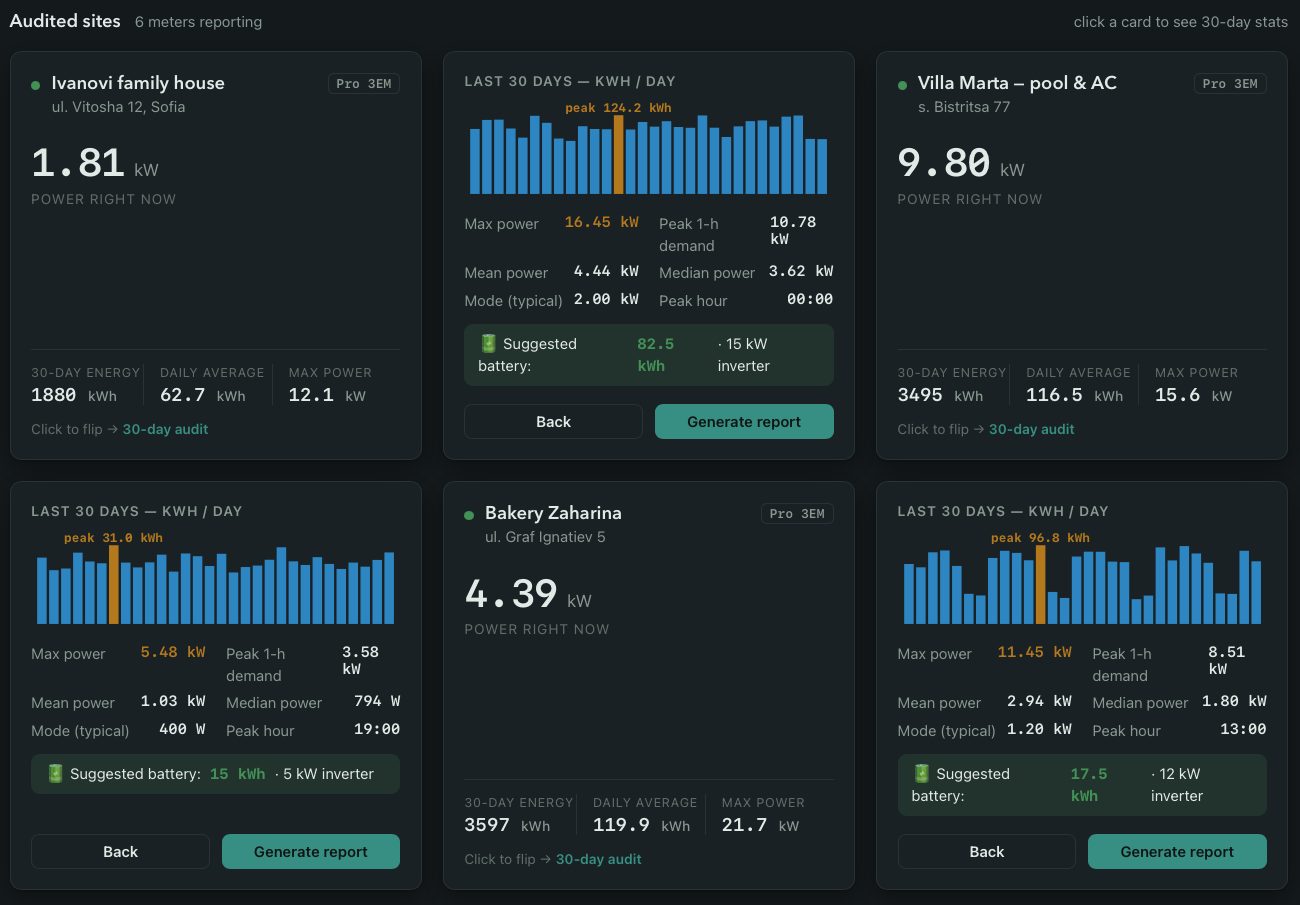
Sizing on facts, not guesses: 30-day audits from live Pro 3EM data — load profile, peak demand and a suggested battery + inverter per site.
The Automation
Then let the sunshine do the work
Once the panels are producing, Shelly devices and the inverter quietly route every spare watt to where it’s worth most without changing their habits:
- Hot water: surplus heats the boiler first. This alone can lift self-consumption by 15–25 points.
- Their EV: charges on sunshine instead of grid power — studies show up to ~46% more self-use for EV owners.
- Their battery: fills from surplus, carries them through the evening.
- Their heat pump: pre-warms the house during the day, so it coasts at night.
- Dynamic tariffs: run loads when power is cheap or sunny.
The Numbers
What it means in euros
For a typical European home, every kilowatt-hour shifted from export to self-use is worth about €0.24. Smart routing alone can raise self-consumption from around 30% to 55–60% — roughly €500 or more saved per year, before adding a battery. With one, 75–85% is realistic. The Shelly control layer costs a few hundred euros and usually pays for itself in under two years — faster than any other part of the system. And you see it happening: live production, live consumption, and the number that matters most — savings this month.
The Relationship
A partnership, not a one-off deal
You stay connected and offer additional services through Shelly Fleet Manager — noticing a fault before they do, keeping devices up to date remotely, and showing them production, consumption, and savings in a friendly way. The result for you will be happier customers, fewer site visits, and a relationship that naturally grows as the home adds an EV, a battery, a heat pump, or a word-of-mouth recommendation.
From the first measurement to years of smooth operation, you are with your customers every step of the way, and Shelly is present at every stage. Shelly devices as the brain. Shelly Fleet Manager as the backbone.
Ready to scale with the Fleet Manager?
Talk to us about your use case — we'll walk you through the platform live.
Book a free demo